Before You Play
The Five-Ring Ledger
The house's real odds, read aloud by one engine wearing five faces.
One Engine, Five Faces
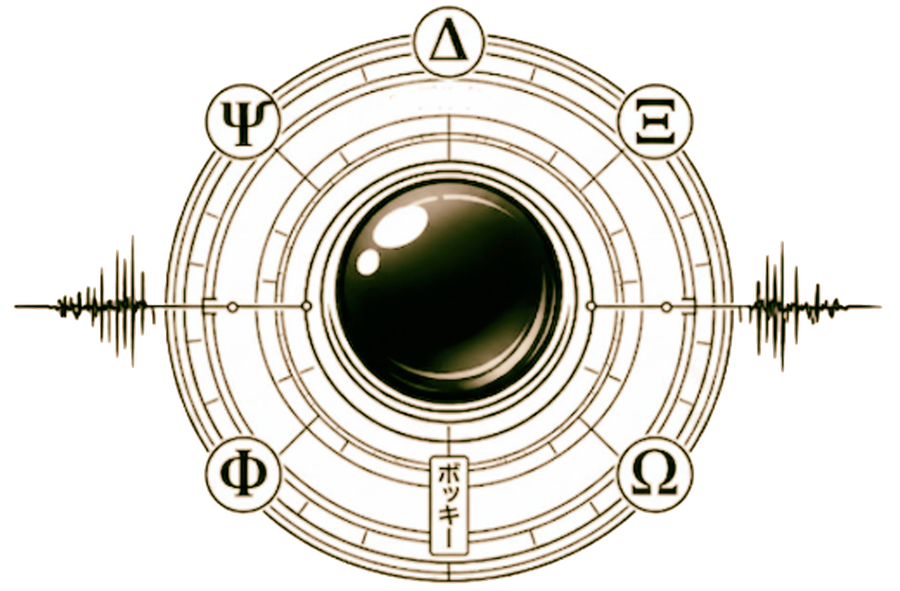
Ψ Λ Ξ Φ Ω
Not five separate systems — one active-inference cycle, wearing five names. Three of these glyphs are, honestly, just what the real variables are already called in the code below.
Psi · The Belief
In the code: mu
What the engine currently believes matters, across 9 real features of the draw history. Starts perfectly flat — no opinions — and only earns its shape one activation at a time.
Lambda · The Update
In the code: the precision-weighted gradient step
How hard mu actually moves once it's been
wrong — scaled by precision, so a feature that's been reliably wrong
earns a confident nudge, and a noisy one earns a cautious one.
Xi · The Error
In the code: predError
The spark that starts every update — how far last round's guess landed from what the draw actually was. No error, no learning; this is where all of it begins.
Phi · The Lens
In the code: phi, literally
9 different ways of looking at the same raw numbers — raw count, recency, parity, distance from center, and more — the actual shape the engine is allowed to perceive.
Omega · The Verdict
In the code: freeEnergy
The one number the whole cycle is quietly trying to shrink — complexity plus error, all in one score. When it's low, the engine writes a number down.
The House Ledger
Same Odds. New Ringmaster.
The odds column is the real, official one — identical to what's printed on the back of any ticket. The last column is just flavour: which part of the cycle above would be sweating hardest at that tier.
| Ring | What It Takes | Real Odds | According To The Engine |
|---|---|---|---|
| ① | 7 winning numbers + Powerball | 1 in 134,490,400 | Ω holds its breath |
| ② | 7 winning numbers | 1 in 7,078,442 | Ω still isn't blinking |
| ③ | 6 winning numbers + Powerball | 1 in 686,176 | Φ swears it's seen this shape before |
| ④ | 6 winning numbers | 1 in 36,115 | Φ's 9 lenses start to agree |
| ⑤ | 5 winning numbers + Powerball | 1 in 16,943 | Λ nudges μ a little harder |
| ⑥ | 4 winning numbers + Powerball | 1 in 1,173 | Λ mid-update, nothing's settled yet |
| ⑦ | 5 winning numbers | 1 in 892 | Ξ shrugs — probably just noise |
| ⑧ | 3 winning numbers + Powerball | 1 in 188 | Ξ: "statistically, a Tuesday" |
| ⑨ | 2 winning numbers + Powerball | 1 in 65 | Ψ barely stirs |
| — | Any prize at all | 1 in 44 | 🎪 Every glyph takes a bow anyway |
Odds of winning are approximate, rounded, and based on one standard game — same figures as printed on any ticket.
The Man Behind The Math
Karl J. Friston
Professor Karl J. Friston
Wellcome Centre for Human Neuroimaging · University College London
In the early 1990s, Friston co-invented Statistical Parametric Mapping (SPM) — the analysis framework still used, in some form, by the overwhelming majority of brain-imaging studies published anywhere in the world. It's one of the most consequential pieces of scientific software ever written, and it's a large part of why citation indexes have, for years running, named him the most-cited neuroscientist alive.
From the mid-2000s on, he turned to a bigger question: why does any living thing — a cell, a brain, you — hold together at all, instead of dissolving into the same disorder as everything else? His answer, the Free Energy Principle, is that every self-organizing system behaves as if it's minimizing "surprise" about the sensory states it expects to encounter. True surprise usually can't be computed directly, so the system minimizes a computable stand-in instead — variational free energy — built from exactly two ingredients:
Complexity — how far current beliefs have drifted from where they started
Inaccuracy — how wrong the last prediction turned out to be
Push the idea one step further and you get Active Inference: an organism doesn't just update its beliefs to match the world (perception) — it also nudges the world to match its beliefs (action). Two ends of the same lever, both quietly minimizing the same free energy. It's now one of the more influential unifying frameworks in neuroscience and computational psychiatry, and a genuine working ingredient in modern machine learning.
This engine borrows that exact machinery — a belief vector, a precision-weighted update, a free-energy score recomputed every round — and points it, gently, at something Professor Friston never had in mind: several hundred draws of Powerball. It's a small tribute wearing a big top hat: real equations, taken seriously, aimed at something entirely unserious. Nothing here would pass peer review, and nothing here is trying to. It's just his math, doing exactly what it does — hunting for structure in noise — pointed at a noise source that, unlike a living brain's world, was built to have none. That's not a flaw in the math. That's the whole disclaimer, really.
The Integrity System
Proof, Not Promises
Four real checks, run against this engine's actual code — not a marketing claim about it. Every statistical test below was validated against known synthetic data before it was ever pointed at anything real.
Check 1 — Is The Lottery Actually Random?
Chi-square goodness-of-fit, against the real draw history
Before anything else: does the raw draw history itself show any statistical departure from true randomness? This is the correct tool for that specific question — a real chi-square test comparing how often each number has actually come up against how often it should, under pure chance. (Kolmogorov-Smirnov and Anderson-Darling, tried first, gave a 77-97% false-positive rate on data KNOWN to be random in testing — they're built for continuous distributions, and 35/20-category discrete draws aren't one. Caught that before it ever reached this page.)
Check 2 — The Free Energy Upper Bound
F = Surprise + KL Divergence
Friston's proof: Free Energy (F) always sits at or above Surprise (−ln P(y), how unexpected an outcome was) — because the gap between them is a KL divergence, and a KL divergence between two real probability distributions can never be negative. That's not an estimate. It's a theorem.
D_KL ≥ 0 always ⟹ F ≥ Surprise always
What can actually break that guarantee isn't the theorem — it's a bug. If this engine's belief (μ, what Friston calls q(s)) ever stopped being a real probability distribution, the guarantee would quietly fail. So rather than assert it, we replayed this engine's own real functions — unmodified — from flat priors across every real historical draw, and checked the promise held every single time.
The Gap Itself — Complexity (F − Surprise)
F and Surprise track each other closely at this scale, so here's the gap between them on its own axis — the exact quantity the theorem says can never cross below the zero line.
Check 3 — Markov Blanket Separation
p(Internal | Blanket, External) = p(Internal | Blanket)
Friston's Markov blanket says an organism's internal states should only ever hear from the outside world through its own senses — never directly. Translated to this engine: the belief (μ) should only ever update through the sensory layer (φ, the 9 engineered features, and the prediction error they produce) — never by reaching past that layer to touch raw history directly.
This one isn't a statistic — it's an architecture check, verified directly against
the live source: Brain.prototype.step()
only ever receives phi
and predError as
inputs to its belief update — both entirely downstream of the sensory layer. No line of
that function reaches around φ to read raw draw history directly. The separation the
theory requires is structural, not assumed.
Check 4 — Predictive Calibration
Hosmer-Lemeshow test, on this engine's own real probabilities
A real, meaningful gap found in this same audit: this engine's raw probability output forces itself to average ~50% no matter what, when the true base rate is ~20% (main) or ~5% (Powerball) — a genuine miscalibration, not a display bug. Fixed with Platt scaling (a standard 2-parameter recalibration, fit on real historical draws via the same machinery validated above) and re-tested with the Hosmer-Lemeshow test — the correct tool for "do these predicted probabilities match real observed frequencies."
The honest reading of the fitted slope (A ≈ 0 for both ball types): there is no real signal in this engine's 9 features for predicting an independent random draw — exactly as the randomness check above says there shouldn't be. Once corrected, this engine's real probabilities sit close to the true base rate for every ball, which is what genuinely calibrated honesty looks like here.
The show's about to start. This performance is for patrons — a coffee gets you a real access code to step inside.
🔒 Patron Access Required
Powerball draws are independent random events. This engine's belief-updating is real math, honestly applied — but it does not, and cannot, change the odds shown above for any future draw.
Play for entertainment, within what you can comfortably afford to lose. If it stops feeling like entertainment, the National Gambling Helpline is free and confidential on 1800 858 858.



Ψ Λ Ξ Φ Ω
心智一流形
Shinchi Ryūkei — Mind-Intelligence, One Manifold
MetaFieldLabs · Active Inference Powerball Engine
Predicted: 5 — Set of Powerball
🎯 Power Picks
Already play the same 7 numbers every week? Enter them below and this runs the exact same historical-overlap analysis the engine runs on its own generated tickets — against numbers you already have, not ones it made up.
The logic: it checks every real historical draw and reports how many main balls your 7 numbers would have matched, and how often, across the last 6 months / 1 year / 1.5 years. It doesn't change the real odds of any future draw — nothing can, these are independent random events — this is a transparency tool, not a forecast.
The real math: with 35 main numbers, there are C(35,7) = 6,724,520 possible 7-number combinations. Power Picks never touches the Powerball, so matching all 7 here is 1 in 6,724,520 — a genuinely different (and easier) question than the jackpot's 1 in 134,490,400, which also requires the Powerball (÷20 more on top). Both are real, published odds — just answering two different questions.
Past Activations
ClearThis Engine's Favorites
Built from your own real Ticket History — not "what other punters like" (we don't have that data, and won't fake it), just which numbers your engine has actually reached for most often across every activation on this device.
Training Record
Download JSONThis brain doesn't reset every time you open the page — its learned beliefs persist in this browser and only grow from genuinely new draws from here on. Each dot below is a real growth event across this brain's whole lifetime, not one session's training curve. "Download JSON" saves this brain's actual learned state (not just a history log) — keep the file if you ever need to move it to another browser or restore it with "Import Brain State" instead of starting over from 0.
This Session's Real Training Curve
Real free-energy values from the training that just ran when this page loaded — a first-time bootstrap shows all 20 real epochs; a returning visit shows the draws that were genuinely new since last time.
Lifetime Growth
Feature-Weight Evolution
Correction for accuracy: this engine does not hold 431
separate "beliefs," one per past draw, or 35 separate beliefs, one per ball. What Free
Energy minimization actually updates is μ (mu) — 9 weights over hand-designed
features (recency, periodicity, parity, distance-from-center, etc.) shared across every
ball — plus π (precision) per weight, which governs how much a prediction
error is allowed to move that weight. A ball's predicted probability is then computed
on-the-fly from these 9 weights, not stored on its own. Below is the real, unmodified
trajectory of those 9 numbers, snapshotted at every growth event from here on — this is
the actual "brain cell" Karl Friston's math is shaping.
μ — Main-ball feature weights
π — Main-ball feature precision
μ — Powerball feature weights
π — Powerball feature precision
Belief entropy over time (H = −Σ μᵢ·ln μᵢ)
Falling entropy means μ is concentrating onto fewer features (growing more confident/opinionated). It flattening out near zero — rather than settling at some middle value — is what real convergence-to-a- degenerate-belief looks like under this specific update rule; that is a property of the math, not a display artifact.